A uniformed woman at the boarding gate makes an announcement in Wolof, and the crowd bursts forth in her direction. “Vous parlez Français?” I ask a woman near me. She shakes her head no and says “Italiano”. My time in Dakar has prepared me for this - the trip to the post office, for instance, where it took half an hour to buy 3 stamps, taught me all I needed to know about how fast things move here, and I’m able to keep a clear head as all semblance of order descends into chaos. Earlier today I’d met Abdou for lunch, and then my cousin’s friend Ndeye. Both of them met me later than our agreed upon time, which I’d grown accustomed to – schedules here are beyond flexible, but when I got back to the house at 8pm it turned out that I was holding everyone up. It wasn’t clear that 8pm was a drop-dead deadline, and I was scheduled to leave for the airport with S, who had an earlier flight than me. The power was out on the block, and everyone was sitting in the living room in the dark. “We almost left without you,” S says to me. I rush upstairs to my room to zip my bags shut – fortunately I’d already packed. I leave several items behind, either because there isn’t room or because I don’t want to bother bringing them back with me: a towel, a bottle of saline solution, half a roll of toilet paper, the shoes I’d worn for two weeks straight and were completely caked in dirt and red dust. Malaal calls my name in thirty second intervals while I scurry around the room in the dark, scanning the space with the miniature flashlight that’s attached to my keychain.
I lug the bags downstairs: my backpack, the suitcase that I’d brought here for Idy – originally filled with gifts to distribute to his family, and a djembe that K had bought and then realized she didn’t have room to take back with her. She’d bought two of them, and was stopping through Poland for a few days to visit family before heading back to Chicago, so I’d offered to take one with me – we don’t live far from each other.
Our goodbyes are rushed. Malaal, Mustafah, Ibou, S and I pile into the car with all our luggage, and head for the airport. Malaal insists on making pit stops – first to pick up the missing stick that goes to a talking drum I’d bought from him, and then to his home to pick up a soccer jersey I’d asked him to buy for me once I grew weary of the haggling process. “You can send the shirt and the stick back with Idy,” I implore, “S is very pressed for time.” Malaal, in control at the steering wheel, will not be moved. His tone is demanding and authoritative. “You asked me to buy the shirt. I bought the shirt, and we’re going to stop at my house to get it,” he says. There is silence in the car. “Do you have gum?” He demands. S thinks he is asking out of concern for our comfort on the airplane, “no, I didn’t buy any for the flight,” she says. “That’s not what I asked,” he says, his voice becoming sharper, “I asked – Do. You. Have. Gum.” My discomfort piques; last night, at Malaal’s request, I had ridden along to the airport with my roommates to see them off, and on the way back he sat in the back seat with me where I thwarted his advances. He’d put his arm around me, taken me by the hand, and asked “are you my friend?” I’d repeatedly removed his hand from my shoulder, released my fingers from his, looked away from him. We’d been in close proximity to each other for two weeks, and just last night had gotten into a deep discussion regarding the societal differences between the U.S. and Senegal – I’d said that I really liked how women could nurse their babies anywhere and everywhere here, and that children were included in every part of life, but I’d never meant to engender this kind of response from Malaal. When I got back to the house all the lights were off and I had to sleep alone in the room I'd shared with my Polish roommates.
It was a rotten way to end our acquaintanceship, and now Malaal, for my benefit, was being difficult. I can’t explain this to S, at least not right now, so instead I pat her on the shoulder and say “you’ll be fine.” She recoils from my touch and says “you knew when we were leaving, and you know how things work here, you were in control! I can’t miss this flight.” Conversation stops in the car as Malaal, Mustafah, and Ibou strain to understand what is being said between S and I in English. “I’m sorry,” I say to S, “if I were you I’d feel the same way.” “Thank you,” she says, staring forward. I watch the clock until we pull up to the departures area at Léopold Sédar Senghor Airport.
I check the djembe and suitcase at the counter, make my way through the long, slow line at security, and find my gate. The seating area is packed. I find an empty seat in the waiting area and ask the woman next to it, a blonde wearing khaki shorts, a knit top, and expensive-looking jewelry, if it’s free. “It absolutely is not!” She says sharply, her arms crossed. Her tone takes me by surprise, “are you…. joking?” I ask. “I most certainly am not, my husband is sitting in this seat,” she says, and crosses her legs to match her arms. I retreat to a wall, where a line has formed, and alternate between sitting on the floor and standing. My flight is due to leave at 11:30pm, gets delayed until past midnight, and then the uniformed woman at the boarding gate makes the announcement.
“I speak English,” a man who has been standing behind me for the past hour or so says. He is dressed in a business suit, wears glasses, and speaks in a soothing tone with an accent I can’t quite place.
“Do you know what’s happening?” I ask.
“I’m not sure,” he says.
“I’m going to see if I can find out,” I tell him, “I’ll be right back.” The uniformed woman is surrounded by passengers demanding information. There is no semblance of a line, and she addresses people in a seemingly random order.
“What’s happened?” I ask her in French when she finally looks at me.
“The flight has been canceled.” She says.
“When is the next flight?” I ask.
“Same time tomorrow.”
“What… what do we do? Where do we go? Do we stay here in the airport until tomorrow?” I ask.
“I don’t know, the airline will be making an announcement,” she replies.
I go back to the wall where the suited man is waiting, and relay the information, take my cell phone out and dial Idy’s number, but the call gets dropped. I’d made arrangements with AT&T for service in Senegal just in case, but this is the first time I’ve had to use my cell phone since arriving here. I try again but the call doesn’t go through, so I call my husband in Chicago and ask him to call Idy for me. Eventually the calls to and from Chicago get dropped too, so we communicate via text message. E’s flight home was later than mine, so I know that Mustafah and Malaal will be back here with the car at some point, but I’m not sure I want to ride back to the house with them alone; I’m not even sure if Idy is staying there tonight. Another announcement is made – there will be buses in the parking lot that will take us to a hotel, the flight to Madrid has been rescheduled to 8am tomorrow. The crowd surges toward the exit, and outside I see Ibou, having just dropped E off at the airport.
“You need to come back?” he asks, searching my face. I touch his shoulder, look him in the eye.
“thank you SO much for finding me Ibou,” I say, thinking about the odds of him actually finding me in this mess, “but the airline is taking us to a hotel. I think it’s best if I go with them because they’ll have to make sure I’m back in time for the flight tomorrow morning. Thank you Ibou, Thank you!” And with that I re-enter the stream of people heading for the buses.
I find the man in the suit and we sit next to each other on the bus. “My name is J,” I tell him.
“Nice to meet you, my name is Ram, short for Rambhujun” he says. We engage in small talk: what we’re doing here in Senegal, how long we’ve been here. Ram is originally from Mauritius, and works at the
University of Bordeaux as a professor of business administration. He was giving a lecture at the local university, and is due back home to teach. The bus pulls up to a long, low building where everyone piles off and walks through a set of automatic sliding glass doors into the lobby of the
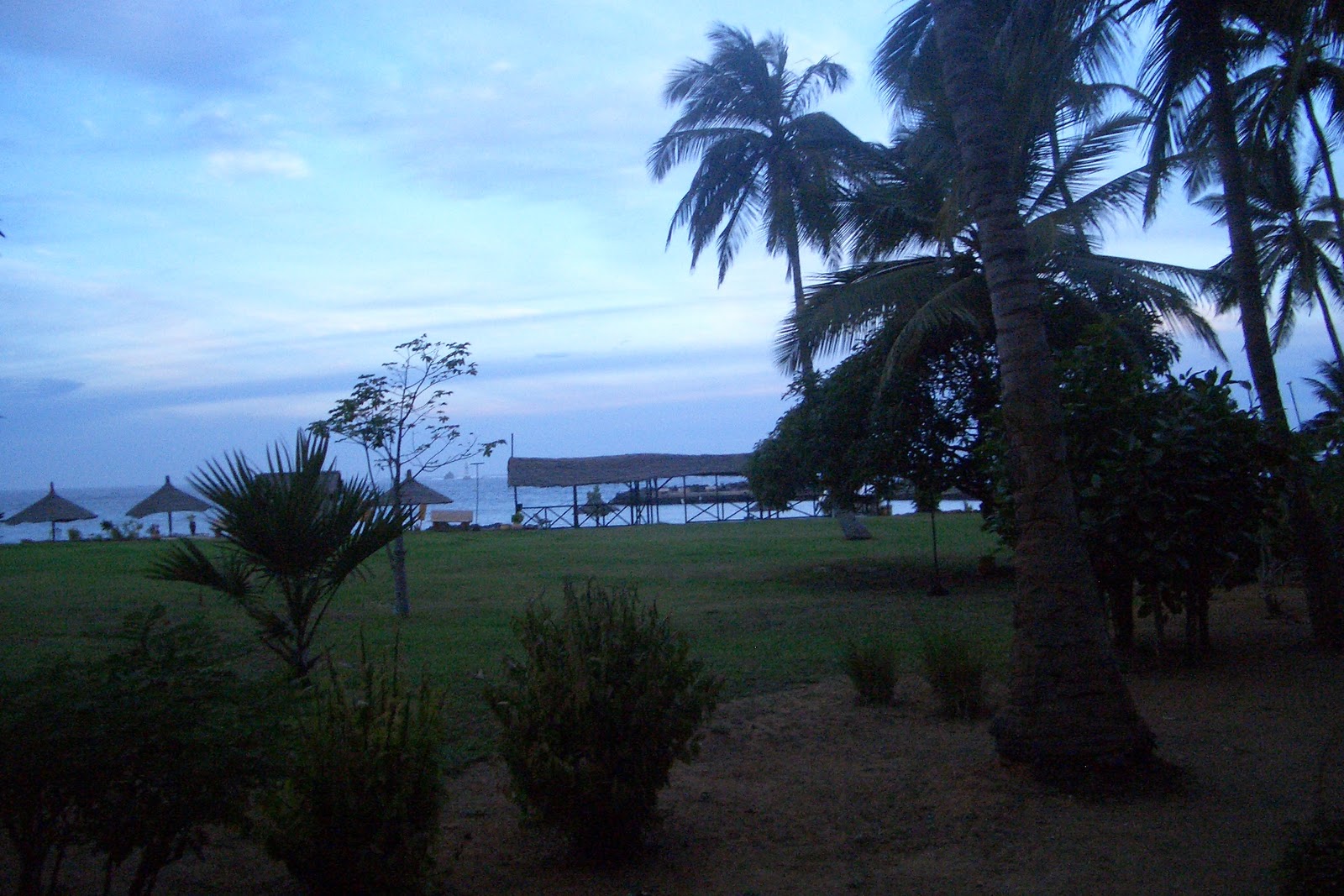
Hôtel des Almadies, a resort hotel.
There is one clerk at the front desk, and two hundred and fifty displaced passengers. The crowd surges toward him like brokers at the opening bell on Wall Street, and the clerk starts handing out forms to whoever is the closest and the loudest. I press my way forward to the reception desk, the crowd pushing me forward until I’m pressed against it. I’m able to maintain my cool as long as I don’t look behind me, I stay holed up inside my mind and absorb the experience as if from a distance. I hold my completed form in my outstretched hand, but the clerk ignores me in favor of louder patrons. When he finally catches my eye and takes the paper from me, he flips it over and returns it to me – there was a second side to the form that I hadn’t filled out. I fill out the backside of the form and hand it to the clerk again, where it is entered into a stack with two hundred and fifty others, in no particular order. He is joined by a second clerk, who takes the stack of papers, and begins reading names and distributing room keys.
My name is finally called and I receive my key, which opens the door to an overwhelmingly opulent suite with a king sized bed, television, sliding glass doors that lead to a patio, bathroom that has western style fixtures, and air conditioning. I am so amazed that I take photos of it. I leave my cell phone on the nightstand and just before I fall asleep, at 3am, get a text from my husband: Du u feel safe where u r staying? I'm feeling a little worried but not too much. I reply: Its pretty swanky actually, by african standards, and theres an english speaking passenger whos taken me under his wing.
In four hours I have to wake up and get ready to pile back on the bus. I climb under the luxuriously soft covers, and rest my head on unimaginably fluffy pillows – for the past two weeks I’ve been resting my head on a balled up sweatshirt, and sleeping on a thin foam mattress in a full sized sheet that’s been sewn together to form a lightweight sleeping bag. It doesn’t take long for sleep to overtake me.
 |
| The fanciest bed I'd seen in weeks. |
 |
| Compare and contrast. |


.jpg)