Thursday, September 30, 2010

September 30th - The Long Way Home, Part II - Léopold Sédar Senghor Airport

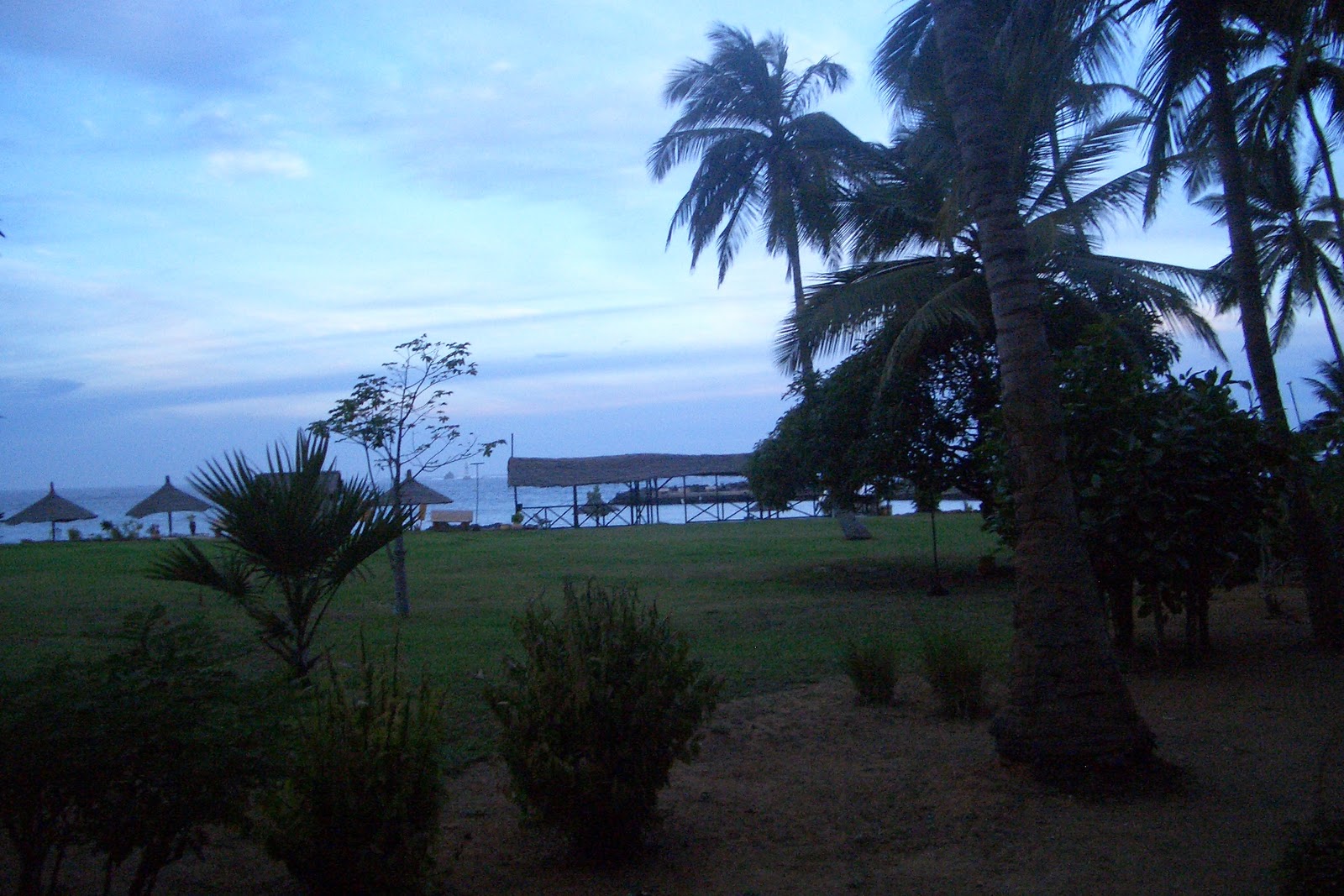
Across the street from the rented house I spent two weeks in.
The view from my hotel suite.  Compare and contrast.
It’s not until I wake that I see how luxurious the hotel I’ve been transported to truly is.  I have an ocean view from the patio of my suite, and breakfast is served in a restaurant with cloth napkins.  The buffet features eggs, sausage, waffles, and most importantly – real coffee.  There has only been Nescafé instant since my arrival; every morning Idy brought a pot of hot water and a tin of the dark, powdery stuff out to the living room floor, along with a box of sugar and a can of condensed milk.  Breakfast was always fresh bread from a local bakery, a chocolate flavored spread, butter, and fresh fruit.  I’ve been drinking the tea that I’d brought with me instead of instant coffee.  I never got a taste for the watery nothingness of Nescafé, but it seems to be a popular beverage in the city - vendors sell it from wheeled carts on sidewalks.  At the hotel, I fix myself a plate of eggs and join Ram - still dressed in his suit, at a table.  I’ve only slept for a few hours, but the hot shower I took – the first since arriving in Senegal, felt like an unquantifiable luxury, and put me at ease.

“You didn’t get dinner last night,” Ram says when I sit down.  There were containers of airline food waiting to be distributed in the lobby amid last night's frenzy, but I hadn't bothered to get one.
“I was so tired by the time I got my room key, I just wanted to go to sleep,” I reply.  It’s sweet that Ram is worried about my food intake, when clearly I have a pile of hot food right in front of me.  I can't eat much of it though, this western-style food is foreign to me now and sits strangely in my stomach. 

After our brief respite we repeat the previous night’s exercise of piling onto buses, and are transported back to the airport.  Having gone through security once already, we are routed through quickly.  There aren’t many officers manning the security checkpoints this early in the morning, and as I peer into an empty security booth I glimpse a computer with an unfinished game of spider solitaire on the screen.

Also repeated is the endless wait at the gate.  Tempers flare as the time drags, Ram breaks his cool exterior responding to a large man who insists that he wait his turn.  “I have been waiting,” he says in perfectly accented, pointedly angry French.  “I have been waiting here as long as you have.”  It's like watching Jean-Luc Picard dress down an insubordinate officer, only with a different accent.  Once everyone finally squeezes their way through the gate, there's a bus on the tarmac that we sit in for at least half an hour before it taxis us to the aircraft, followed by a slow, agitated climb up a staircase into the craft itself.  I wonder if I will ever get home.  It isn’t until we’ve all been seated for some time that we get an explanation for last night’s cancellation: there had been a snowstorm in Madrid, the region was unprepared for the weather, resulting in mayhem on the roads and airports.  No flights have been able to arrive or depart since late last night.  

Once we finally, definitively take off, exhausted passengers all around me cover their heads with airline blankets, the only parts of them visible are calves and feet.  Making my way down the aisle to use the bathroom I feel like I'm participating in some kind of performance piece, or anti-war demonstration where people drape themselves in cloth to represent the dead.  The bathroom is fetid and lacks toilet paper, but I've gained valuable squatting skills.  I proudly hover over the toilet receptacle, victorious in the face of filth.  I return to my seat serene;  I've successfully left Dakar, now all that's left to navigate is Madrid.


Wednesday, September 29, 2010

September 29th - The Long Way Home, Part I - Dakar

A uniformed woman at the boarding gate makes an announcement in Wolof, and the crowd bursts forth in her direction.  “Vous parlez Français?” I ask a woman near me.  She shakes her head no and says “Italiano”.   My time in Dakar has prepared me for this - the trip to the post office, for instance, where it took half an hour to buy 3 stamps, taught me all I needed to know about how fast things move here, and I’m able to keep a clear head as all semblance of order descends into chaos.  Earlier today I’d met Abdou for lunch, and then my cousin’s friend Ndeye.  Both of them met me later than our agreed upon time, which I’d grown accustomed to – schedules here are beyond flexible, but when I got back to the house at 8pm it turned out that I was holding everyone up.  It wasn’t clear that 8pm was a drop-dead deadline, and I was scheduled to leave for the airport with S, who had an earlier flight than me.  The power was out on the block, and everyone was sitting in the living room in the dark.  “We almost left without you,” S says to me.  I rush upstairs to my room to zip my bags shut – fortunately I’d already packed.  I leave several items behind, either because there isn’t room or because I don’t want to bother bringing them back with me:  a towel, a bottle of saline solution, half a roll of toilet paper, the shoes I’d worn for two weeks straight and were completely caked in dirt and red dust.  Malaal calls my name in thirty second intervals while I scurry around the room in the dark, scanning the space with the miniature flashlight that’s attached to my keychain.

I lug the bags downstairs: my backpack, the suitcase that I’d brought here for Idy – originally filled with gifts to distribute to his family, and a djembe that K had bought and then realized she didn’t have room to take back with her.  She’d bought two of them, and was stopping through Poland for a few days to visit family before heading back to Chicago, so I’d offered to take one with me – we don’t live far from each other. 

Our goodbyes are rushed.  Malaal, Mustafah, Ibou, S and I pile into the car with all our luggage, and head for the airport.   Malaal insists on making pit stops – first to pick up the missing stick that goes to a talking drum I’d bought from him, and then to his home to pick up a soccer jersey I’d asked him to buy for me once I grew weary of the haggling process.  “You can send the shirt and the stick back with Idy,” I implore, “S is very pressed for time.”  Malaal, in control at the steering wheel, will not be moved.  His tone is demanding and authoritative.  “You asked me to buy the shirt.  I bought the shirt, and we’re going to stop at my house to get it,” he says.  There is silence in the car.  “Do you have gum?” He demands.  S thinks he is asking out of concern for our comfort on the airplane, “no, I didn’t buy any for the flight,” she says.  “That’s not what I asked,” he says, his voice becoming sharper, “I asked – Do. You. Have. Gum.”  My discomfort piques; last night, at Malaal’s request, I had ridden along to the airport with my roommates to see them off, and on the way back he sat in the back seat with me where I thwarted his advances.  He’d put his arm around me, taken me by the hand, and asked “are you my friend?”   I’d repeatedly removed his hand from my shoulder, released my fingers from his, looked away from him.  We’d been in close proximity to each other for two weeks, and just last night had gotten into a deep discussion regarding the societal differences between the U.S. and Senegal – I’d said that I really liked how women could nurse their babies anywhere and everywhere here, and that children were included in every part of life, but I’d never meant to engender this kind of response from Malaal.  When I got back to the house all the lights were off and I had to sleep alone in the room I'd shared with my Polish roommates.

It was a rotten way to end our acquaintanceship, and now Malaal, for my benefit, was being difficult.  I can’t explain this to S, at least not right now, so instead I pat her on the shoulder and say “you’ll be fine.”  She recoils from my touch and says “you knew when we were leaving, and you know how things work here, you were in control!  I can’t miss this flight.”  Conversation stops in the car as Malaal, Mustafah, and Ibou strain to understand what is being said between S and I in English.   “I’m sorry,” I say to S, “if I were you I’d feel the same way.”  “Thank you,” she says, staring forward.  I watch the clock until we pull up to the departures area at Léopold Sédar Senghor Airport.

I check the djembe and suitcase at the counter, make my way through the long, slow line at security, and find my gate.  The seating area is packed.  I find an empty seat in the waiting area and ask the woman next to it, a blonde wearing khaki shorts, a knit top, and expensive-looking jewelry, if it’s free.  “It absolutely is not!” She says sharply, her arms crossed.  Her tone takes me by surprise, “are you…. joking?” I ask.  “I most certainly am not, my husband is sitting in this seat,” she says, and crosses her legs to match her arms.  I retreat to a wall, where a line has formed, and alternate between sitting on the floor and standing.   My flight is due to leave at 11:30pm, gets delayed until past midnight, and then the uniformed woman at the boarding gate makes the announcement. 

“I speak English,” a man who has been standing behind me for the past hour or so says.  He is dressed in a business suit, wears glasses, and speaks in a soothing tone with an accent I can’t quite place.
“Do you know what’s happening?”  I ask.
“I’m not sure,” he says. 
“I’m going to see if I can find out,” I tell him, “I’ll be right back.”  The uniformed woman is surrounded by passengers demanding information.  There is no semblance of a line, and she addresses people in a seemingly random order.
“What’s happened?” I ask her in French when she finally looks at me. 
“The flight has been canceled.”  She says. 
“When is the next flight?” I ask. 
“Same time tomorrow.” 
“What… what do we do?  Where do we go?  Do we stay here in the airport until tomorrow?”  I ask.
“I don’t know, the airline will be making an announcement,” she replies. 

I go back to the wall where the suited man is waiting, and relay the information, take my cell phone out and dial Idy’s number, but the call gets dropped.  I’d made arrangements with AT&T for service in Senegal just in case, but this is the first time I’ve had to use my cell phone since arriving here.  I try again but the call doesn’t go through, so I call my husband in Chicago and ask him to call Idy for me.  Eventually the calls to and from Chicago get dropped too, so we communicate via text message.  E’s flight home was later than mine, so I know that Mustafah and Malaal will be back here with the car at some point, but I’m not sure I want to ride back to the house with them alone; I’m not even sure if Idy is staying there tonight.  Another announcement is made – there will be buses in the parking lot that will take us to a hotel, the flight to Madrid has been rescheduled to 8am tomorrow.  The crowd surges toward the exit, and outside I see Ibou, having just dropped E off at the airport. 
“You need to come back?” he asks, searching my face.  I touch his shoulder, look him in the eye.
“thank you SO much for finding me Ibou,” I say, thinking about the odds of him actually finding me in this mess, “but the airline is taking us to a hotel.  I think it’s best if I go with them because they’ll have to make sure I’m back in time for the flight tomorrow morning.  Thank you Ibou, Thank you!”  And with that I re-enter the stream of people heading for the buses.

I find the man in the suit and we sit next to each other on the bus.  “My name is J,” I tell him.
“Nice to meet you, my name is Ram, short for Rambhujun” he says.  We engage in small talk: what we’re doing here in Senegal, how long we’ve been here.  Ram is originally from Mauritius, and works at the University of Bordeaux as a professor of business administration.  He was giving a lecture at the local university, and is due back home to teach.  The bus pulls up to a long, low building where everyone piles off and walks through a set of automatic sliding glass doors into the lobby of  the Hôtel des Almadies, a resort hotel.

There is one clerk at the front desk, and two hundred and fifty displaced passengers.  The crowd surges toward him like brokers at the opening bell on Wall Street, and the clerk starts handing out forms to whoever is the closest and the loudest.  I press my way forward to the reception desk, the crowd pushing me forward until I’m pressed against it.  I’m able to maintain my cool as long as I don’t look behind me, I stay holed up inside my mind and absorb the experience as if from a distance.  I hold my completed form in my outstretched hand, but the clerk ignores me in favor of louder patrons.   When he finally catches my eye and takes the paper from me, he flips it over and returns it to me – there was a second side to the form that I hadn’t filled out.   I fill out the backside of the form and hand it to the clerk again, where it is entered into a stack with two hundred and fifty others, in no particular order.  He is joined by a second clerk, who takes the stack of papers, and begins reading names and distributing room keys.

My name is finally called and I receive my key, which opens the door to an overwhelmingly opulent suite with a king sized bed, television, sliding glass doors that lead to a patio, bathroom that has western style fixtures, and air conditioning.  I am so amazed that I take photos of it.  I leave my cell phone on the nightstand and just before I fall asleep, at 3am, get a text from my husband:  Du u feel safe where u r staying? I'm feeling a little worried but not too much.  I reply: Its pretty swanky actually, by african standards, and theres an english speaking passenger whos taken me under his wing.

In four hours I have to wake up and get ready to pile back on the bus.  I climb under the luxuriously soft covers, and rest my head on unimaginably fluffy pillows – for the past two weeks I’ve been resting my head on a balled up sweatshirt, and sleeping on a thin foam mattress in a full sized sheet that’s been sewn together to form a lightweight sleeping bag.  It doesn’t take long for sleep to overtake me.

The fanciest bed I'd seen in weeks.
Compare and contrast.

Tuesday, September 28, 2010

September 28th - Random Thoughts

  • Something smells terrible in the house, but my husband can't smell it.  Is it me?
  • I totally made my friend drive me home tonight; I'm a dork. 
  • I've been back at work for one day and I'm already thinking about my next day off.
  • There's algae growing in our filtered water thing.
  • There's three days left to the September Blog Challenge.
  • There's nothing to eat in the house except bread from the Wealthy Street Bakery in Grand Rapids.
  • Because Michigan is an irony-free zone, south of Wealthy Street is a bad neighborhood.
  • Thursday some water sealing people are coming over to look at the basement; I hope we can get it fixed soon.
  • Just for fun, we looked at house listings in Grand Rapids; we could buy a giant house there for $100K.  I probably couldn't find a job there though.  Also, we'd have to live in Grand Rapids. 
  • Not that there's anything wrong with that.
  • I scared our upstairs neighbor last night because he didn't hear me knock on the back door.  I had a box of treats from Wealthy Street Bakery in my hands and he happened to open the door because he was about to feed our cats.  He got so freaked out he closed the door in my face.  Even though I knew it was reflex, I was sort of insulted.
  • We've started watching season 1 of The Wire on Netflix, it's really good.
  • I saw The Funny Ha-Ha Show tonight, it was great.
  • Wendy McClure read at the Funny Ha-Ha Show, I've been reading her column in Bust magazine for years, I was all starry eyed meeting her in person.
  • My eyeballs feel weird.
  • I don't do Twitter, but I get the feeling that if I did, my tweets would be a lot like this blog post.

Monday, September 27, 2010

September 27th - On the way back from Grand Rapids

The roads were clear until we got to the Dan Ryan, where traffic was heavy.  A man in the car next to us rolled down his window, pulled a piece of bright green gum from his mouth, and dropped it out the open window.  It stuck to the door of his SUV like a gigantic booger.  I hope that piece of chewed up gum stayed on that car the whole way home.

Sunday, September 26, 2010

September 26th - Notes from The Brayton House

I.  I first came here in May with Angelica, we needed a hotel in Grand Rapids on our way to and from the U.P.  We wanted something close to the Amtrak station, and were hoping for something cheap.  Someone was smart enough to make their website bandbofgrandrapids; it was the first listing that came up when I typed those words into a Google search. "Goooood morning, Brayton House, this is George, how can I help you?" a man with a radio announcer's voice answered when I called.  I told him the dates we needed, and he described each of the three rooms available -- what kind of bed was in it, how much it cost per night.  The smaller rooms were $80 a night, and the big room with bay windows was somehow only $5 more.  I said we wanted the big room, and asked if it was possible to get two beds.  George paused, and asked: "Well, what's the situation, are you two ladies?"  "Yes," I said, barely containing the urge to laugh.  "There's a cot that we can bring in but it's not very comfortable," he said.  I said it was probably fine just to have the one bed, but before booking the room he made me call Angelica first to clear it with her.  "No way, I'm not sleeping with you," she said, in her flattest sarcastic voice, which can be mistaken as serious if you don't know better.  I called back to reserve the room, and George asked if I had a credit card.  "Just to hold the room," he explained, "we accept cash, checks, and credit cards, but we prefer cash because the bank fees are killing us." "Okay," I said.  "We take Visa, MasterCard, and American Express," he continued, "do you have one of those?"  "Yes," said.  "Well if you've got that rascal out, I'll take the number now," he said.  I relayed this tidbit to Angelica.  "All I can say is," she said, "welcome to my people." 

II.  In our room, there were stacks of old magazines: Smithsonian; National Geographic; The New Yorker.  I read a 1976 New Yorker article on the Carter v. Ford Presidential race.

III.  In every room is a sheet of paper that explains, in flowery, italicized font, the house rules:

No rules - No regulations

Most of our guests are ladies and gentlemen, who are just naturally decent and orderly, and are considerate of the rights of others, therefore, the "rules and regulations" they have applied to their own lives are much better than any printed list we might suggest.


To that very small minority of people who through ignorance or just plain cussedness, smoke or burn candles in the building, endangering the lives of all our guests, who drink loud and long, who have their televisions going full blast when others have turned in for the night, who think it is their (right) privelege (sic) to take towels and other articles when they leave, who throw refuse most anyplace, who feel the entire water supply belongs to them, who allows (sic) their children to roam the building without supervision, and who leave a dirty mess in the rooms.


A list of "rules and regulations" a mile long wouldn't change their habits of living, therefore, none has been applied.


We enjoy having you as our guest and hope your stay is pleasant and memorable.

IV.  Also in every room is a brief history of the house, typed on letterhead with a black and white rendering of the building in the header:

THE BRAYTON HOUSE
516 College Street

James P. Brayton was the builder and original owner of the house we are enjoying this evening.

Mr. Brayton was born November 23, 1840 in the state of Wisconsin.  At age 15 he moved to Michigan and earned his living as a county surveyor in Ottawa County.  He was assisted in his job by his father.  Through this position he came in contact with men who were making history in Michigan lumbering operations.  Some of these individuals were:  T.R. Lyons, T. Steward White, and Thomas Friant.  Mr. Brayton himself became well known all over the United States.

In addition to buying and selling lumber for himself, his signature was accepted as the last word regarding the value of standing lumber.  Mr. Brayton was a quiet man and aside from being an early member of the Masonic Lodge, he was not a figure in society and did not take part in public life.  He built this house in 1889.  The architecture of the house is called Georgian Revival and it is listed on the National Historical register.

The next owner of this house was Stewart Foote, President of Imperial Furniture Company, which at one time was the largest manufacture (sic) of quality tables in America.  Mr. Foote occupied the house from 1920-1935.

In 1935, James McInerny, (President of McInerny Spring and Wire Company, the world's largest manufacturer of seat springs for automobiles) purchased the home.  He and his family lived here until 1945.  During their ownership, the kitchen and bathrooms were remodeled and wallpapers were put up.  They also adjusted the size of the ballroom on the third floor in order to add three extra bedrooms.  The Carriage House was made into living quarters at about the same time.

In 1945, Mr. McInerny gave the house to the Catholic Diocese and it was used as a residence for priests until 1970.

Mr. Walter Kehres, Director of Waldon Village, an alternative high school, purchased the home in 1970.

In September 1971, the property was bought by Gene and Phyllis Ball.  Mr. Ball passed away in 1976.  Mrs. Ball continues to reside in the home, as well as rent out some of the guest rooms to tenants.

V.  Phyllis likes to serve breakfast early.  I'm here again in September, this time with my husband.  We're visiting Holly and Jeremy, who were already putting up several people in their apartment; the Brayton House is only about a mile from them.  "What time do you want breakfast?" Phyllis asked us when we checked in.  "We're here visiting friends, and we'll probably sleep late tomorrow," I said. "So, nine o'clock?" She asked, her unblinking eyes fixed on me from behind her wire-rimmed glasses.  M considered saying something jokey about nine o'clock not really being late, at least not to us, but reconsidered.  "Um, we're meeting our friends for breakfast," I said, "I don't want to trouble you with making breakfast for us, but thanks."

VI. Phyllis reminds me of David Letterman's mother.

VII.  Phyllis leaves two After Eight mints on a little red tray on the nightstand when she makes up the room.  Angelica thought they were condoms.

VII.  There's a WiFi connection, but it's not very good.

IX.  I went for a run in the morning, then took a shower.  Phyllis opened the door to the bathroom while I was drying off.  I gasped as I saw the top of her gray head, which only comes up to my shoulders, and held a bright yellow towel between my body and the widening crack in the door.  "Oh sorry," she said loudly, closing the door, "sorry, I wasn't sure where you'd gone or where you were."  "That's okay," I said from inside the bathroom.

X.  There are 20 rooms in this house, and only 3 are rented out to guests.  There's an entire floor I haven't seen, not to mention the carriage house.  The wallpaper, bathroom and kitchen fixtures date from 1935-1945.  Antiques and curios are everywhere, including quilts hung from picture molding on the walls.

XI.  Someone at the end of the hall, in the residential part of the house, has a TV or radio turned on at a low volume all day, and I can hear people walking on the floor above us.

XII.  In May, on our way back from the U.P., Angelica and I stayed in the same room with the bay windows that we'd stayed in on our way north.  We sat on the porch eating burgers from Black Castles - a burger joint that looks like it operates out of the converted living room of somebody's house, has a pool table, framed photos of Malcolm X and Tupac, and a TV set that blared infotainment news when we walked in.  Our order came to $7.50; the cashier - who was the only other person there besides us, couldn't break $8 so he gave us back $1.  Angelica found two quarters in her purse so that we could pay what we owed.   On the walk back, we realized we'd just visited the neighborhood where, back when the Brayton House was first built, the day servants lived.  A group of  Heritage Hill tourists  stared at us from across the street.  One of them walked over to us and asked: "Do you own this house?". 
"Yes," Angelica said, in her flattest sarcastic voice, which can be mistaken for serious if you don't know better.

Saturday, September 25, 2010

September 25th - Michigan State Motto

If you seek a pleasant peninsula, look about you.

Friday, September 24, 2010

September 24th - Dance Recital; Lunch with Abdou

Chadit and her dance troupe (Chadit in the center)
Idy's daughter and Chadit's son at the recital
Closeup of the beads and fabric
On our last night together as a group, we danced in the courtyard of the Centre Culturel Blaise Senghor to a small audience consisting of Idy and his family, Malaal, Ibou, our dance teacher Chadit, the drummers who provided live percussion for us at every dance class, and members of the dance troupe that Chadit works with professionally.  She outfitted us in traditional dresses and jewelry from her own collection; I wore a blue dress with bright stripes, a matching headdress, and two thick coils of multicolored beads that crossed my body from the shoulder to the waist, forming an X.  We danced in the open air in our bare feet, performing the dance that Chadit had taught us, and when the dance was finished we did it a second time - Idy and the others joining us at the end and forming a circle.  We took turns dancing in the center, showing off our best moves.  Later, at the house, Idy praised our performance in his understated way.  "That was good," he said, a small curl of a smile on his face as he watched the scene replayed on a hand-held video camera that K had brought with her.  Abdou stopped by the house; he had planned on attending the performance but had been called away by business.  Idy showed him the video and they watched together.

My roommates left for Poland that night, and I was once again alone in the room.  It felt strange, and I had trouble sleeping.  The next day I packed my bags and waited for Abdou; we had lunch plans.  He drove me out to his house, in a neighborhood where government officials lived.  After spending two weeks in the rented house, it was strange to see such relative opulence; his was easily the largest and most ornate house I'd seen.  He introduced me to his wife, son, daughter, and grandson.  Abdou has four grown children, and two grandsons; about half of them live in the house with him.  He kept his earbud on at all times; it seemed Abdou was always on the clock.  He took a call while giving me a tour of the house, and wore the apparatus while we ate lunch.  I misunderstood something that he said - he asked if I wanted to eat at the dining room table, or with "les gens."  I understood this to mean "with the people."  I wasn't quite sure what Abdou meant by this, and said that the dining room table was fine.  Apart from the time I went to dinner with my cousin's friend Ndeye, it was the only meal in Senegal that I'd eaten at a table with silverware.
Abdou's house

We discussed the Alliance Française, where Abdou had taught first my husband, and then me.  He asked what my fellow classmates were up to: Kim is now married and has two young sons; Caroline is in graduate school; Carla is studying to become a medical coder.  I mentioned my current teacher, Tim, who is American but speaks French like a native.  I said that Tim was learning Swedish, to which Abdou replied: "really, maybe he wants to marry a Swedish woman."  I almost choked.  Tim shows up to class wearing Hermès shirts, frequently breaks into song during class (he heavily favors Céline Dion), and openly discusses his personal life with his students.  To even the most casual observer it is clear that Tim does not want to marry any woman, Swedish or otherwise.  I marveled - if that's the right word, at Abdou's absolute cultural blindness to what for me is a very obvious fact.  Homosexuality is essentially not recognized in Senegal, and Abdou was unable to pick up on the fact that he had a gay colleague at the Alliance Française.

Abdou's grandson
I had noticed that in the absence of any outwardly visible signs of gayness, men were much more affectionate with each other in Dakar than in Chicago.  At the house one evening, over the course of a late night conversation, Malaal and Mustafah were both reclining on the mattress in the living room that Idy and his family used as their bed.  They lay on their sides, propped on on one elbow, so close to each other that they were practically spooning.  "Um... yeah, maybe he does want to marry a Swedish woman," I finally replied, not wanting to blow Abdou's mind.

In Abdou's courtyard - note that he is on the phone
Later he showed me the second floor of the house, where his family was eating, African style, on the floor; I now understood what Abdou meant by eating with "les gens."  "I didn't mean that I didn't want to have lunch with your family," I said, and suddenly felt very stupid.  I recalled a moment a few years earlier when Abdou had come to my house and made mafé, a stew made with peanuts.  He'd been fascinated by the fact that we kept animals inside our home.  I'd seen plenty of cats and dogs in Dakar, but none of them were pets.  They ate garbage, humped each other in the streets, and were treated as vermin.  More than once I'd secretly invited a cat to come closer, and Malaal would wave his cane at the animal and hiss.  Animals were only kept if they were useful - like the goats that Malaal and Chadit kept in a pen behind their home.  In my home, Abdou had asked about the decorations (of the antique banjo mounted on the living room wall he'd said: "that's an African instrument"), but he seemed most fascinated by our cats.  He asked what they were named, what they did, what they ate.  He told us about an uncle of his who lived alone and kept a dog, as if this were the strangest thing a man could do.  I thought he'd asked everything he possibly could when a look of deep concentration came over his face.  "Where do they go to the bathroom?" he asked me in French.  "Um, in a... a box, in a closet" I replied, and, not knowing the exact French words for it (we'd never studied this in class) said, "there's.... sand that they do their needs in.  Afterward... we throw it away."  "And it's in the house?"  Abdou asked.  "Yes," I replied.  Abdou's curiosity was not satisfied until I showed him the litter box.